
Basic3QAQC (B3Q) Toolkit
The B3Q Toolkit is designed for mining professionals who need reliable, standardised QA/QC. It aligns with international best practices to ensure precision, compliance, and confidence in your data.
The Basic3QAQC application helps mining teams and laboratories achieve reliable, standardised analytical QA/QC for all assay data. Following international best practice, it ensures precision and accuracy while giving users confidence in their results. “From Data Control to Data Understanding,” it helps teams move beyond routine checks to truly understand their results.
Basic3QAQC complements traditional rule-based database QA/QC for added confidence, but it also functions independently, providing an investigative, understanding-focused approach to analyse sampling data with true insight into both precision and accuracy.
Whether working independently or as part of a larger organisation, the Basic3QAQC application makes analytical QA/QC audits and evaluations straightforward, efficient, and accessible.
Built on the trusted JMP platform, the Basic3QAQC application delivers advanced functionality within a stable, self-contained environment. This minimises external risks and ensures consistent, uninterrupted performance, making it ideal for organisations that prioritise reliability, precision, accuracy, and meaningful data understanding.
Built on JMP Statistical Discovery
B3Q Toolkit is a powerful add-in for JMP that leverages the analytical and statistical capabilities of JMP’s statistical discovery engine. By combining B3Q’s domain expertise in laboratory QAQC with JMP’s advanced statistical tools, you get reproducible, publication-ready analyses that meet ISO 17025 compliance requirements.
B3Q Toolkit Features
Comprehensive Statistical Analysis
Full-spectrum analysis, including precision, accuracy, contamination checks, and advanced outlier detection, all in one package.
Proprietary Outlier Detection & Method Precision
Leverage our unique Method Precision for accurate, tailored outlier detection and precision assessment, specifically designed for mining assay results.
Automated Data Logging & Auditing
Seamlessly log every result in an audit-ready format for easy future reference and compliance.
Customizable Analysis Parameters
Fully customizable lookup and control tables to tailor the analysis process to your specific requirements.
Smart Control Table Generation
Automatically generate control tables based on available data in your system (customization may be required depending on your setup).
Lab-Specific Precision Benchmarking
Use Method Precision to calculate lab-specific precision benchmarks from historical data, compare new results, set meaningful standards, and monitor ongoing lab performance.
Instantaneous Data Processing
Analyse large datasets quickly and efficiently, ensuring timely, reliable results without sacrificing accuracy.
Proven, Reliable Software
Built on the trusted power of JMP, ensuring reliable and stable performance backed by industry-leading analytical tools.
Comprehensive Training & Support
Access both standard and personalized training, plus dedicated support to ensure smooth implementation and ongoing success.
Expert Development Team
Our experienced team is continually improving the toolkit to meet evolving industry needs.
Effortless Installation
Get started quickly with simple, straightforward installation — just download and go.
Direct Database Integration
The option is available to pull lab data directly from your own database into the software for enhanced efficiency.
Core Modules
Blanks & Standards
%Bias Analysis
B3Q Blanks & Standards is designed to calculate the accuracy and bias of laboratories by comparing analysed elements to known statistics for various Certified Reference Materials (CRMs), including Blanks.
Audience: Lab managers, quality officers, geochemists
More →Method Precision
Lab performance Analysis — also used for identifying outliers
Method Precision is defined as the best level of precision a laboratory can achieve using a specific analytical method. It is expressed as a confidence interval (usually at 99.7% or 3RSD) within which results are expected to fall for a specific grade, element, and method.
Audience: Lab managers, quality officers, geochemists, analytical chemists, method validation teams
More →Paired Data
%Precision Analysis
Paired Data Analysis is designed to calculate the precision of laboratories across various elements by comparing two readings of the same sample.
Audience: Lab managers, mine geologists, resource consultants
More →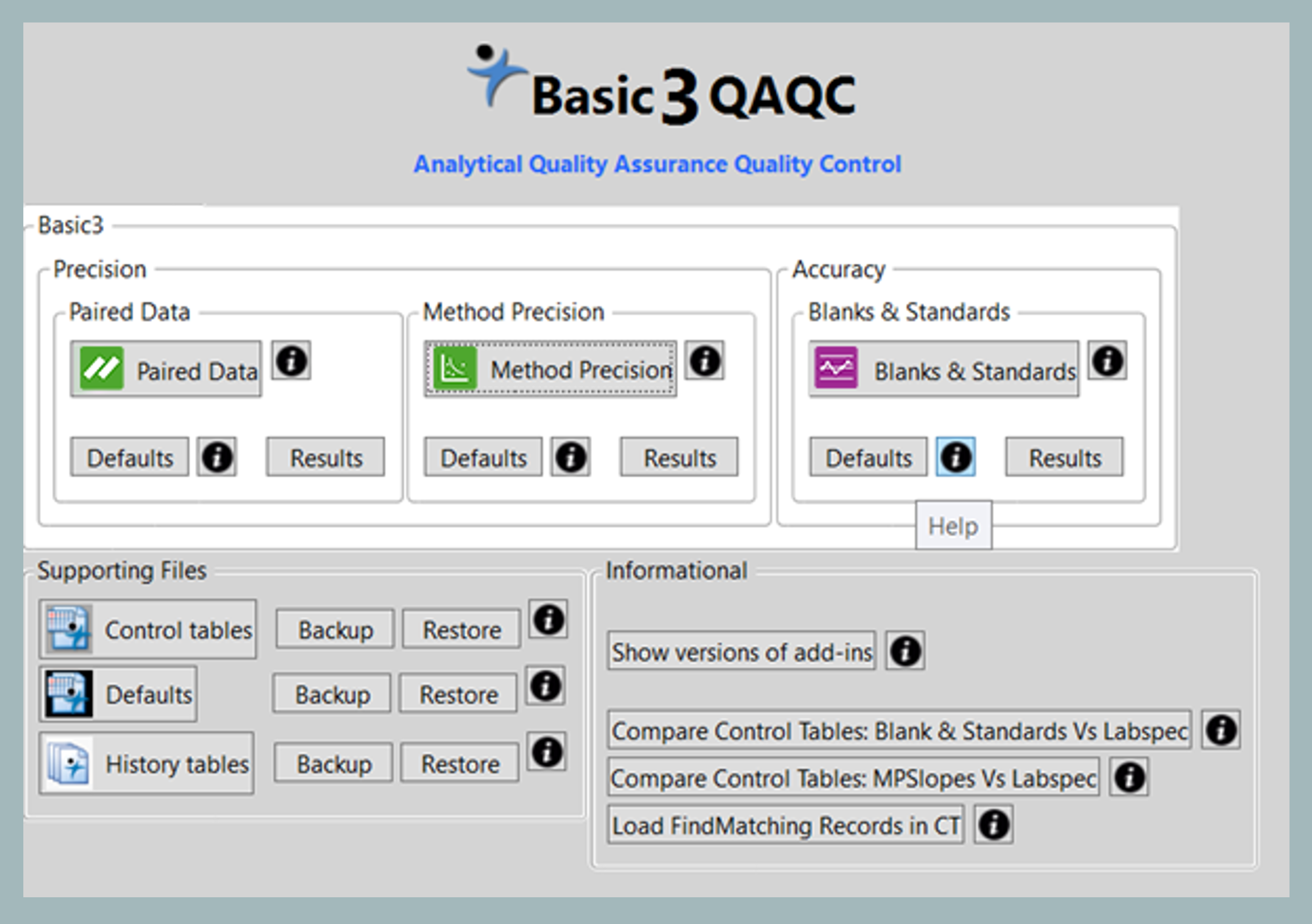
Blanks & Standards — %Bias Analysis
The Blanks & Standards module imports CRM and blank data directly from your Database or spreadsheet exports. It computes percentage bias for each standard against certified values, flags outliers using Method Precision rejection criteria, and generates control charts that track laboratory performance over time.
Core Functionality
- ✓ Simultaneous Analysis: The system analyses all elements found in a data table at once.
- ✓ Bias Calculation: It specifically identifies the bias of a lab across different analyzed elements.
- ✓ CRM Comparison: It evaluates accuracy by comparing sample results against known CRM statistics. Certain samples, such as relative density, can be forced to run as a CRM if needed.
- ✓ The “Assist”: This feature provides high-level automated advice at the end of a run, warning users about issues like “Too many outliers” or “No blanks found”.
Reporting and Outputs
- ✓ Multiple Formats: Detailed reports for every element are generated in both JMP Journal and PDF formats.
- ✓ Summary Reports: A main journal provides a summary of all analyzed elements.
- ✓ Report Types: Users can choose between a Client Report (shorter and focused on interest points) or a more detailed Internal Report.
- ✓ Customizable Storage: All journals and tables are saved to a user-specified directory path.
Method Precision
Method Precision is defined as the best level of precision a laboratory can achieve using a specific analytical method. It is expressed as a confidence interval (usually at 99.7% or 3RSD) within which results are expected to fall for a specific grade, element, and method.
Core Concept and Influencing Factors
The precision of a lab is not static; it depends on several variables:
- ✓ Analytical and Instrumental Techniques: The specific equipment and methods used.
- ✓ Sample Characteristics: The element being analyzed, its grade, the matrix, and the particle size of the sample.
- ✓ Grade Range: A precision curve model is used to calculate precision across different grade ranges using paired data.
Key Applications
- ✓ Calculating Lab Precision: It establishes a confidence interval for specific conditions, meaning that if 100 identical samples are analysed, 99.7% should fall within this range.
- ✓ Supporting Paired Data Analysis: It calculates the intercept and slope for specific elements and labs, which are then used in Twin Stream or Paired Data Analysis.
- ✓ Updating Standard Deviations: It provides a way to calculate a more realistic Standard Deviation for a lab’s actual performance on a specific CRM, rather than relying solely on the certified SD which may be unrealistic for that lab.
- ✓ Comparing Laboratories: It allows for a direct comparison of performance; a lab that analyses samples within a smaller confidence interval is considered more accurate than its competitors.
Paired Data — Duplicate & Check Sample Analysis
Paired Data Analysis is designed to calculate the precision of laboratories across various elements by comparing two readings of the same sample.
Core Functionality
- ✓ Precision Calculation: The system focuses on precision, typically using data consisting of two readings for the same sample (e.g., Pt1 and Pt2).
- ✓ Outlier Detection: Data is checked for outliers using a specific Method Precision technique. If no existing specifications are found in the control tables, the system defaults to the KSigma outlier method.
- ✓ Simultaneous Processing: Like other tools in the series, it analyzes all elements found in a data table at the same time.
- ✓ The “Assist”: This feature provides high-level advice regarding probable problem issues identified during the analysis.
Data Types and Purposes
The application handles several types of paired data, each serving a different quality control purpose:
- ✓ Pulp-Replicate Data: Samples analysed twice at the same lab to determine Intra-lab Precision.
- ✓ Check Data: Samples sent to a secondary lab to determine Inter-lab precision.
- ✓ Blind Pulp Duplicates: Remainder of pulp re-submitted to the primary lab with a different ID to test long-term precision.
- ✓ Field Duplicates: Duplicate samples taken in the field to test the sampling technique.
- ✓ Coarse Duplicates: Samples split during the preparation stage (e.g., at the 3mm milling stage) to test sample preparation at the lab.
Reporting and Outputs
- ✓ Journal Formats: Reports are generated in both JMP Journal and PDF formats.
- ✓ Main Journal: Provides a high-level overview of the analysis process for each element and includes a copy of the “Assist” results. It also contains links to more detailed reports.
- ✓ Detailed Reports: For every element analyzed, a specific detailed report is created and stored in a directory specified by the user.
Connection to Method Precision
Paired Data analysis is closely linked to Method Precision. The Method Precision script is used to calculate the intercept and slope for a specific element and lab, which is then used to evaluate the paired data stream. This relationship helps monitor precision across different grade ranges.
Trusted by Certified Laboratories
B3Q is used by ISO 17025-accredited laboratories across Southern Africa for routine QAQC reporting and compliance documentation.
Training Programme
A QA/QC course covering the theory, Intro to JMP, Basic3QAQC Toolkit and practical case studies using your own laboratory data.
| Day/Part | Topic | What You Learn |
|---|---|---|
| Part 1 | QA/QC Basic Principles | Theory of analytical quality analysis quality control, CRM selection, %bias calculations, control chart interpretation. |
| Part 2 | Pass/Fail Criteria + Case Studies | Preparation duplicates, slope & intercept analysis, HARD calculations, duplicate & check sample evaluation, inter-laboratory comparison techniques. |
| Part 3 | Facilities in JMP Software to Support QA/QC Analysis | Intro to JMP and its facilities that are effective in QA/QC analysis. |
| Part 4 | Using Basic3QAQC for Analytical QA/QC | How to apply the Basic3QAQC program. |
Please note:
- This course can be taken Onsite or Online. For Online the course can be split over two days.
- QA/QC course can also be offered based on particular needs your company may have.
- QA/QC course without the link to JMP Software and Basic3QAQC can also be offered.
- Other JMP Software courses are also available for offering Onsite training.
QAQC Best Practices Guide

Download our QAQC Best Practices PDF
A practical reference covering CRM selection, control charting, outlier treatment, and ISO 17025 compliance requirements.
Download PDFFrequently Asked Questions
Does B3Q require JMP software?
What data formats are supported?
How long does setup take?
Is B3Q aligned with ISO 17025 requirements?
Why would I use B3Q when my Mining Database also gives me stats?
What B3Q Is Used For
Basic3QAQC (B3Q) is used for data quality assurance and workflow efficiency. The software handles Certified Reference Materials (CRMs), blanks, and duplicates within sample batches to monitor accuracy and precision. B3Q creates exception views that highlight failures or out-of-specification results, deciding whether to accept, reject, or flag data for a re-run.
B3Q serves as an auditing tool to verify results from built-in database analysis tools, and is used to check results at a laboratory level to ensure quality outcomes.
Who Uses B3Q?
The people using QAQC software daily are usually very few — but extremely critical.
Analytical Laboratory
- • Laboratory Manager
- • QA/QC Officer
- • Analytical Chemist
Mine & Resource
- • Senior / Resource Geologist
- • QA/QC Manager
- • QA/QC Geologist
- • Process Metallurgist
Built for the Mining Laboratory
B3Q was developed in close collaboration with working laboratories to address real-world QAQC challenges. Laboratory Managers and QA Managers rely on B3Q for the lab's overall performance and compliance, while Metallurgists and Resource Geologists use it to ensure the quality data that underpins resource estimation and operational decisions.
Get Started with B3Q
Whether you need automated QAQC reporting, consulting support, or training for your laboratory team — we are ready to help.
e-Mail:
Tel: +27 12 346 4823